What is HPC?
What is HPC?
High Performance Computing (HPC) generally refers to the practice of aggregating computing power in a way that delivers much higher performance than what a typical desktop computer or workstation can offer. This enhanced capability is used to solve large problems in science, engineering, or business.
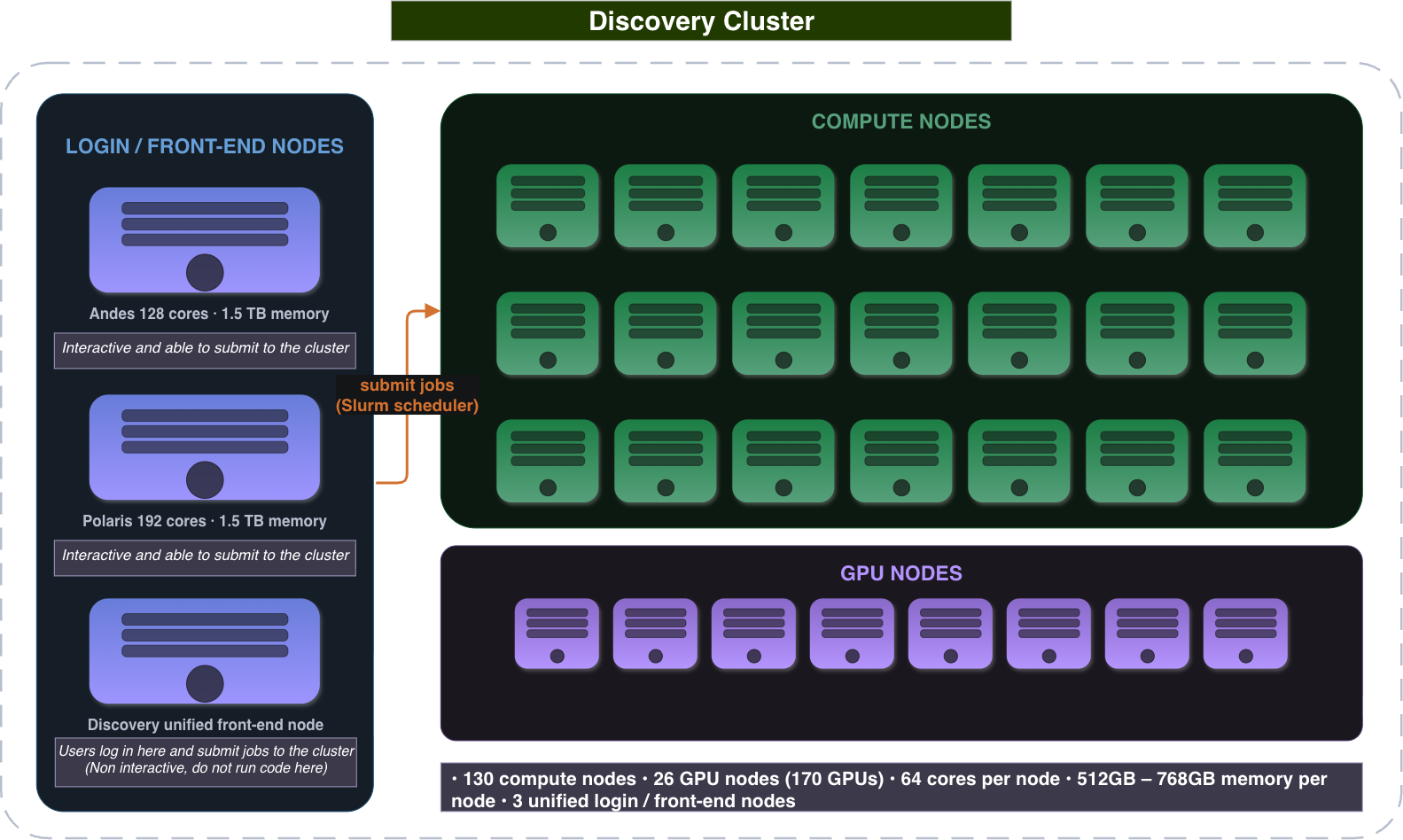
At Dartmouth, we have access to both large-scale shared memory platforms (Andes and Polaris) and a cluster (Discovery) with many nodes, or a set of individual machines connected through a high-bandwidth network.
Keep in mind that Dartmouth’s HPC systems are shared resources used by the entire research community. This is especially important when working on Andes, Polaris, or the login node of Discovery.
Andes and Polaris are intended for interactive use, much like a personal computer. Being a responsible user means monitoring your processes carefully to avoid excessive use of CPU or memory resources.
Discovery, on the other hand, is primarily designed for batch-scheduled jobs submitted through a scheduler. When you log into Discovery, you’re on the login node—a shared entry point for all users. It’s appropriate for lightweight tasks like compiling code or monitoring jobs, but not for running or testing programs. Running intensive computations on the login node can negatively impact all users, potentially blocking job submissions and affecting system stability.
Why do we use HPC?
An important concept in high-performance computing (HPC) is understanding the difference between shared memory and distributed memory models. Standard systems, such as laptops and desktops, use a shared memory model in which all components within a single machine access the same memory space. In contrast, HPC systems often use a distributed memory model, where computational tasks are spread across multiple compute nodes—each with its own private memory. Communication between nodes is typically handled over a network, making data exchange an explicit part of the computation.
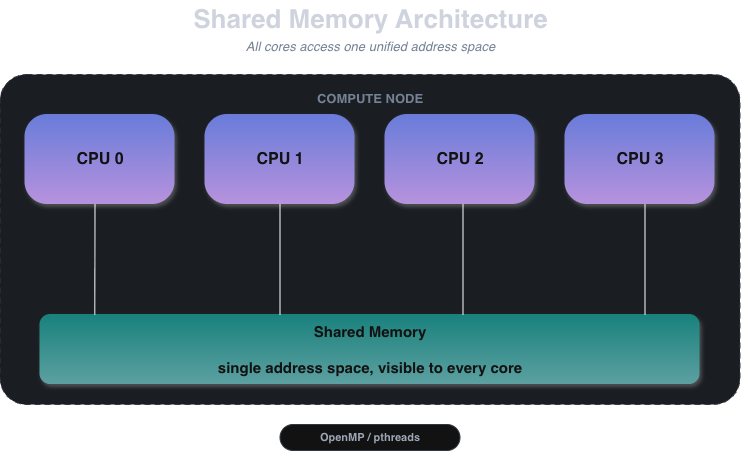
Shared Memory
All the cores on the node are looking at the exact same block of memory. When CPU 0 writes a value, CPU 1 can read it immediately — there's no copying or sending involved, because there's only one copy of the data to begin with. This makes communication essentially free (just a memory access), but it only works within a single node, since you can't physically wire cores in different machines into the same memory.
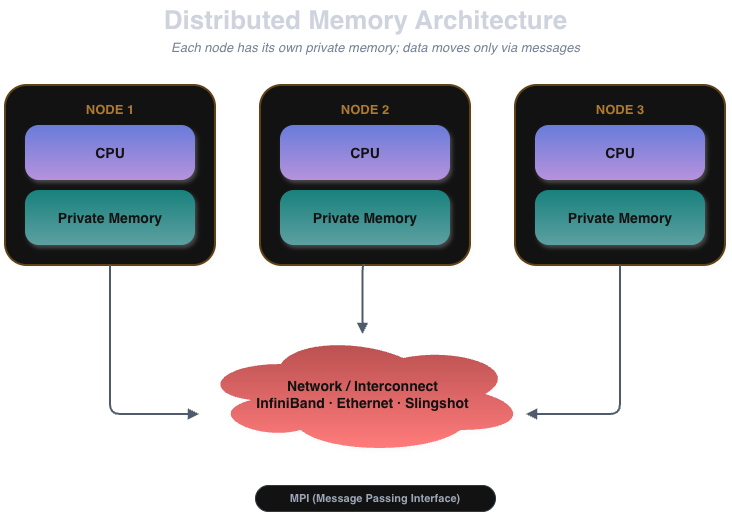
Distributed Memory
Each node has its own private memory that no other node can see or touch directly. If Node 1 needs a value that lives in Node 2's memory, it has to explicitly ask for it — Node 2 packages up the data and sends it as a message over the network (that's what MPI is doing under the hood). This adds latency compared to shared memory, but it's what lets a cluster scale to hundreds or thousands of nodes, since you're no longer limited by how much memory can physically live in one machine.